Energy-Saving Technology

Technology

Sustainable hardware technology for the future

  • HOME
  • PORTFOLIO
  • Technology

Smart Adapter

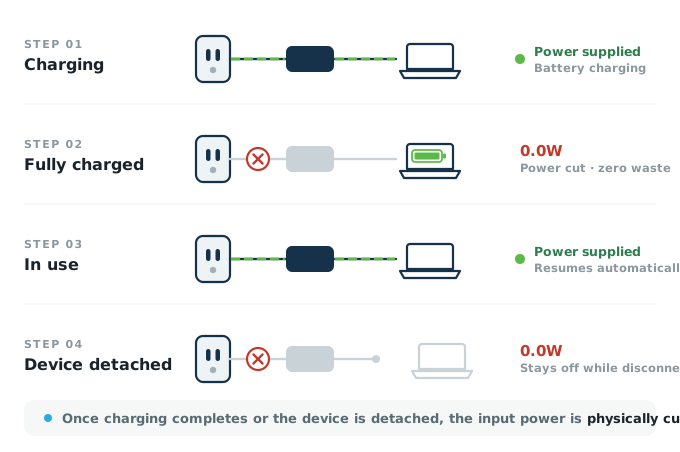
Cuts the input power automatically once charging completes or the device is unplugged, bringing consumption to 0.0W. Delivers carbon neutrality in the use phase (Scope 3).

Applications
  • Notebook adapters
  • Robot vacuum chargers
  • E-bike chargers
  • EV chargers
  • Mobile phone chargers
  • Power tool chargers
Smart adapter operation — charging, fully charged, in use, device detached

Smart Carbon Reducer

Covers both non-smart legacy appliances without any communication feature and modern IoT appliances that draw power continuously just to stay connected. It brings the appliance's standby power and the control device's own consumption to 0.0W at the same time — an “absolute standby mode”.

PILLAR 01

Current-based auto-calibration

Measures and self-learns the appliance's own standby current reference on first start-up. Even on devices with wide load swings such as inverters or motors, it rules out unexpected cut-off malfunctions.

PILLAR 02

Occupancy & multi-sensor fusion

Even while an appliance is running, if the occupancy sensor confirms the user is absent it pre-emptively transmits an IR power-off signal, then cross-checks environmental sensor trends to verify that control succeeded.

PILLAR 03

Physical isolation of network standby

Overcomes the chronic 1W–3W draw of smart appliances maintaining Wi-Fi and Bluetooth. Relay/FET dual-isolation circuitry fully disconnects the AC power line.

PILLAR 04

Absolute standby mode & self-protection

Halts the control device's own power supply at the same moment it cuts the appliance, taking the whole system to 0.0W. A supercapacitor or battery keeps an ultra-low-power deep sleep alive while preventing battery over-discharge.

Value proposition

  • Complete standby elimination — true 0.0W, fully isolated from the grid, network standby included
  • Space-aware carbon reduction — pre-emptively blocks waste caused by user absence, supporting corporate Scope 3 goals
  • Two-way state synchronisation — sensor cross-checking eliminates remote-control failures and state mismatches
  • Scalability — one standard spanning both legacy electronics and IoT ecosystems

Standby Power Zero Module

A module that detects when use has ended and cuts standby power to 0.0W. It is embedded into the product's own control board.

Application method

  • Embedded type — built into the control board during manufacturing, with no change to the exterior

Applicable products

  • TV
  • PC · monitor
  • Washing machine
  • Induction hob
  • Air conditioner
  • Microwave
  • Refrigerator · freezer
  • Water purifier
  • Bidet
  • Printer
  • Production equipment

Benefits

  • Removes a building's permanent base load in the most economical way
  • Extends the life of existing infrastructure while supporting ZEB certification criteria
Home appliances covered by the standby power zero module
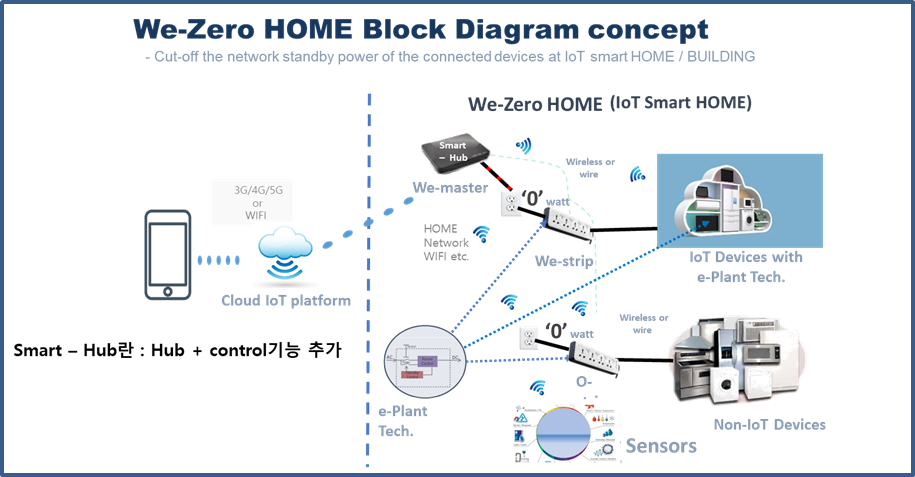
We-Zero Home block diagram — Smart-Hub and We-strip cutting network standby power to zero

IoT Smart Home — We-Zero Home

Brings the network standby power consumed purely to stay connected in an IoT smart home down to zero, realising a genuine IoT smart zero home and building.

Advantages

  • Zero not only network standby but ordinary standby power as well
  • Less waste than a conventional home, making carbon neutrality achievable
  • Smart-Hub (We-master) with We-strip manages both IoT and non-IoT devices

What is wrong with today's IoT smart homes

  • Building a smart home with Apple HomeKit, Samsung SmartThings or LG ThinQ causes network power consumption to surge, with carbon emissions expected to follow — working against carbon neutrality and driving climate change.
  • There is a mistaken assumption that an AI- and IoT-enabled smart home can only be achieved by increasing power consumption.

Smart Streetlight

An intelligent, multi-mode streetlight system that physically cuts daytime standby power and responds to driver visual safety and real-time road conditions. A next-generation standard for smart city road lighting that maximises urban energy efficiency.
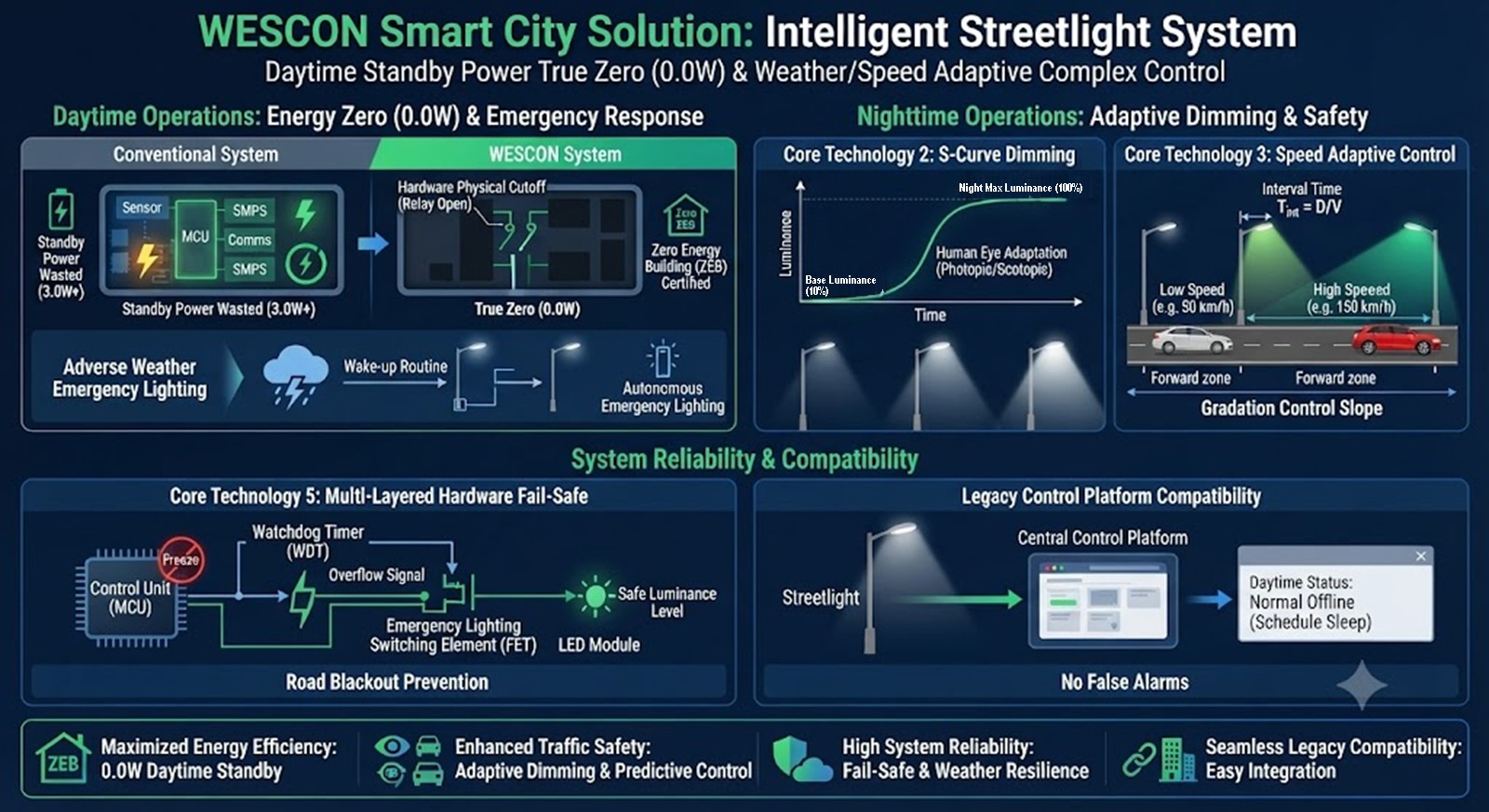
  • Daytime standby True Zero (0.0W physical cutoff) — disconnects the power line at circuit level during daylight hours, eliminating the 3.0W-plus leakage current conventional streetlights consume.
  • Network-independent S-curve dimming transition — each unit identifies the day–night transition autonomously through its own illuminance sensing, even in communication shadow areas, modelling the eye's photopic and scotopic adaptation curves to remove glare stress.
  • Vehicle speed-adaptive forward prediction — synchronises driving speed with streetlight spacing to pre-illuminate the road ahead, giving a flicker-free driving environment.

System configuration

WESCON smart city solution — intelligent streetlight system

Safety mechanisms and expected benefits

Safety mechanisms

  • Autonomous severe weather response — an intermittent wake-up routine performs emergency lighting during heavy rain, snow or fog even while in daytime cutoff mode.
  • Legacy platform compatibility — reports the daytime saving state as “Normal Offline” to existing control platforms, preventing false alarms.
  • Multi-layered hardware fail-safe — if the control program freezes, a hardware watchdog forces the emergency lighting element (FET) to conduct, preventing road-wide blackout.

Expected benefits for smart cities

  • Maximised energy efficiency — 0.0W daytime standby across millions of streetlights
  • Improved traffic safety — smooth dimming aligned to biological visual rhythms and speed-adaptive prediction
  • Non-stop operation — autonomous operation in communication shadow areas with multi-layered fail-safes
  • Infrastructure compatibility — integrates with existing control systems without large-scale network replacement